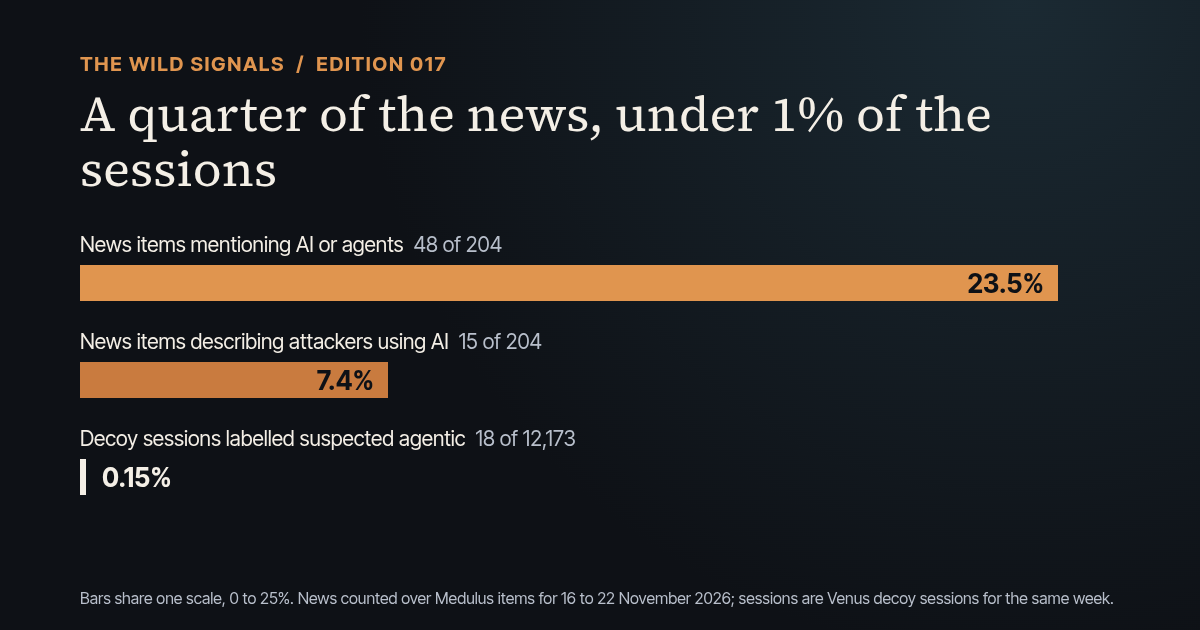

About a quarter of this week’s security reporting mentions AI, and 18 of the decoys’ 12,173 sessions, 0.15%, were labelled suspected agentic reconnaissance.
SECTION 01
What the signals mean
Events recorded on the Venus decoys fell 34.0% this week, to 990,834 from 1,501,915, and distinct sources fell 14.8%, to 5,113 from 6,002. The Windows surface supplied 915,753 of the events. Every other surface together rose 17.2%, to 75,081 from 64,067. 2,666 sources were new and 2,447 had been seen before, against 3,536 and 2,466 in Edition 016.
About a quarter of the news mentions AI
Medulus recorded 204 news items this week. 48 of them, 23.5%, mention AI or agents, and 15 of those, 7.4%, describe attackers using it. Barracuda linked a cloud breach to the ARTEX attack tool (SecurityWeek, Bleeping Computer). Bleeping Computer reports the autonomous tool Cairn used to find a zero-day and take over a server. Amazon says China-linked attackers’ AI agents exploited a medical software zero-day (SecurityWeek). Bell Canada says an agentic attacker stole enterprise customer data. The European Commission confirmed an AI-assisted cyberattack disrupted services. Google reports attackers using AI agents to build and run exploits from software patches. The rest of the 48 include vendor launches, funding rounds, policy and supply chain incidents involving AI tools.
On the decoys, 18 sessions
Venus labelled 18 of 12,173 sessions, 0.15%, as suspected agentic reconnaissance. Requests matching the exploit paths of the Langflow and Flowise AI workflow builders rose to 9 from 3, from four sources against one, and probing requests rose to 7 from 1. Together that is 16 of 990,834 events. The decoys recorded no findings for Artex, Cairn or Hermes.
Nine flaws joined the exploited list, three of them over 200 days old
Between 17 and 20 November, CISA added nine vulnerabilities to its catalogue of flaws confirmed as exploited. Puppet Enterprise came on 17 November. REDCap, Apache Axis, Synology DiskStation Manager and LiteLLM came on 18 November. Apache Roller, VMware vCenter, Cisco Expressway and SAP NetWeaver came on 20 November. Edition 016 had twelve additions, ten of them within eight days of publication.
Reported use
Bleeping Computer reports the vCenter authentication bypass exploited since September, and The Hacker News attributes it to Armory Castle, a China-nexus group, more than ten weeks before the 19 November patch. Cisco Expressway was exploited against a Russian organisation soon after a public proof of concept appeared, with four devices breached (The Hacker News, SecurityWeek). Apache says Roller is under active exploitation, and SecurityWeek reports the Roller and Axis flaws exploited in attacks. The Hacker News reports Puppet exploited, and Rapid7 reports exploitation of the Axis flaw against Atlassian Confluence Data Center, with N-able N-central also exploited.
Java4Shell exploitation attempts began before any listing
CVE-2026-114938, nicknamed Java4Shell, is a pre-authentication code execution flaw in Java 17 that affects applications including Jira, Jenkins and Keycloak (The Hacker News). It comes from Base64 decoding with AVX-512 enabled (CISA advisory VA-26-321-01). SecurityWeek reports exploitation attempts began as vendors rushed out advisories on 19 November, and CISA urged immediate patching. It is not on the catalogue and carries an exploitation forecast of 0.4564.
LiteLLM was listed after 222 days
CVE-2026-40217, a LiteLLM code execution flaw published on 10 April, was added to the catalogue on 18 November. A second LiteLLM flaw, CVE-2026-42208, has been on the catalogue since 8 May. Its forecast is 0.8942, and Metasploit changed its scanner module on 17 November. Amazon reported an AI agent campaign targeting LiteLLM, Dify and other applications for API keys on 16 November.
Secrets requests came from a narrower pool
Requests for secrets and configuration files rose 14.1%, to 22,616 from 19,821, from 194 sources against 514. That is about 117 requests per source against 39. Distinct paths rose to 1,302 from 1,277. /.env drew 412 requests, /.git/config 274, /.env.production 214 and /.env.local 210, and /.env.backup drew 189. Terraform state, the record of the servers and passwords a cloud build created, drew 96 requests for the root file against 46, and 72 for the nested file against 47, while the three archive paths fell between 16% and 52%.
Traversal and PHP requests rose from few sources
Traversal requests rose 31.7%, to 981 from 745, from 14 sources against 50, across 105 distinct paths against 56. Two paths led with 25 requests each: /....//....//....//..../.env and the same prefix ending at /proc/self/environ, the running program’s environment variables. The folder variants /assets../.env, /build../.env and /css../.env drew 25 each. Requests carrying the PHP remote include pattern rose 50.0%, to 171 from 114, from six sources against four. The pattern maps to CVE-2012-1823, which is on the catalogue, and all 17 sessions carrying it were automated.
API, Portal and Database events rose
API events rose 94.9%, to 6,326 from 3,245, and Portal events rose 95.2%, to 6,323 from 3,239. Database events rose 36.3%, to 2,228 from 1,635, and MySQL credential attack requests rose 35.9%, to 1,767 from 1,300, from 96 sources against 84. Auth events rose 26.6%, to 4,630 from 3,657. VPN events fell 8.8%, to 4,718 from 5,171, and gateway fingerprinting fell to 4 requests from 11. Windows file sharing probes fell 14.3% and file sharing credential attacks fell 15.5%. SSH access probing fell 11.7%, to 14,365 from 16,268, and invalid-user enumeration fell 11.7%, to 13,377 from 15,151. Requests for server-side script files fell 16.3%, to 4,457 from 5,323, and admin console requests rose 14.1%, to 2,109 from 1,849.
The fingerprint cluster edged up
The remote desktop tool identified by fingerprint 73ede1f461b6 ran from 97 addresses and produced 1,730 sessions, against 90 addresses and 2,192 sessions in Edition 016.
My view
The reporting describes agents working inside victims and against named software. The decoys recorded 18 sessions and 16 workflow-builder events.
Seven of the nine flaws were forecast below 0.06, and all nine were being exploited. Three had been public for more than 200 days, so a listing can arrive long after the first fix.
Fewer sources asked for secrets this week, 194 against 514, but each asked about three times as often. Requests for the root Terraform state file doubled, to 96 from 46.
None of the 48 flaws Medulus qualified appears among the 15 identifiers Venus recorded. 99.2% of the CVE-identified hits on the decoys are for flaws from 2022 or earlier, and 22 of the 48 qualifiers carry 2026 identifiers.
What to act on
Patch VMware vCenter, Cisco Expressway, Apache Roller and SAP NetWeaver first, as their federal deadlines are 23 November. REDCap, Apache Axis and Synology DiskStation Manager were due 21 November. Puppet is due 1 December and LiteLLM 2 December. Apache Axis 1.x is end of life, so migrate it. Apply the Java 17 updates for Java4Shell and check Jira, Jenkins and Keycloak. Rotate the API keys stored in LiteLLM and Dify deployments. Remove environment files, Git directories, Terraform state and site archives from any path a web server can reach.
16 Nov – 22 Nov 2026
16 Nov – 22 Nov 2026
990,834 external events (−34.0%). 5,113 distinct sources (−14.8%). 12,173 sessions (−17.2%).
Against Edition 016’s published figures, events fell from 1,501,915 to 990,834, sources from 6,002 to 5,113 and sessions from 14,698 to 12,173. New sources fell 24.6%, to 2,666 from 3,536, and returning sources fell 0.8%, to 2,447 from 2,466. By surface, Shell fell 11.7% to 14,365 from 16,268, Web rose 18.3% to 36,491 from 30,852, Database rose 36.3% to 2,228 from 1,635, API rose 94.9% to 6,326 from 3,245, Portal rose 95.2% to 6,323 from 3,239, Auth rose 26.6% to 4,630 from 3,657, VPN fell 8.8% to 4,718 from 5,171 and Windows fell 36.3% to 915,753 from 1,437,848. Active campaigns fell 55.7%, to 824 from 1,858, and 661 are flagged recurring, against 1,424.
Ranked signals
| Rank | Signal | Events | Ed. 016 | Change | Sources | Score |
|---|---|---|---|---|---|---|
| 1 | PHP Injection / Remote Include | 171 | 114 | +50.0% | 6 | 0.4391 |
| 2 | AI Workflow Builder Exploit Attempts | 9 | 3 | +200.0% | 4 | 0.4313 |
| 3 | SSH Campaign Targeting | 945 | 1,137 | −16.9% | 51 | 0.3741 |
| 4 | AI Workflow Builder Probing | 7 | 1 | +600.0% | 4 | 0.3500 |
| 5 | MySQL Credential Attack | 1,767 | 1,300 | +35.9% | 96 | 0.3363 |
| 6 | Webshell / RCE Script Probing | 4,457 | 5,323 | −16.3% | 203 | 0.3128 |
| 7 | Directory / Path Traversal | 981 | 745 | +31.7% | 14 | 0.3065 |
| 8 | SMB Credential Attack | 110,569 | 130,792 | −15.5% | 40 | 0.3005 |
| 9 | Sensitive File & Secret Exposure | 22,616 | 19,821 | +14.1% | 194 | 0.2787 |
| 10 | Automated Scanner / Recon Tooling | 967 | 783 | +23.5% | 92 | 0.2323 |
| 11 | VPN Gateway Fingerprinting | 4 | 11 | −63.6% | 1 | 0.2210 |
| 12 | Admin Console Discovery | 2,109 | 1,849 | +14.1% | 139 | 0.1606 |
| 13 | SMB Access Probing | 121,541 | 141,849 | −14.3% | 1,969 | 0.1565 |
| 14 | SSH Invalid-User Enumeration | 13,377 | 15,151 | −11.7% | 317 | 0.1564 |
| 15 | SSH Access Probing | 14,365 | 16,268 | −11.7% | 728 | 0.1357 |
SQL injection probing recorded no request, against 1.
Remote desktop fingerprint campaigns
| Client signature | Sessions | Ed. 016 | Change | Sources | Ed. 016 | Change |
|---|---|---|---|---|---|---|
TLS 73ede1f461b6 | 1,730 | 2,192 | −21.1% | 97 | 90 | +7.8% |
| RDP cookie "anonymous" | 155 | not published | – | 19 | not published | – |
Fingerprint 73ede1f461b6 rose from 90 addresses to 97 while its sessions fell. The "hello" cookie and TLS fingerprint 43e25370946f, both published in Edition 016, are no longer among the ten largest campaigns, the smallest of which ran 116 sessions.
Path families
| Family | Events | Ed. 016 | Change | Paths | Ed. 016 | Sources | Most requested |
|---|---|---|---|---|---|---|---|
| Sensitive File & Secret Exposure | 22,616 | 19,821 | +14.1% | 1,302 | 1,277 | 194 | /.env (412), /.git/config (274) |
| Backup & Archive Download Probing | 288 | 735 | −60.8% | 26 | 385 | 53 | /terraform.tfstate (96), /.terraform/terraform.tfstate (72) |
| Webshell / RCE Script Probing | 4,457 | 5,323 | −16.3% | 834 | 1,366 | 203 | /index.php (200), /phpinfo.php (162) |
| Admin Console Discovery | 2,109 | 1,849 | +14.1% | 205 | 369 | 139 | /admin/.env (130), /actuator/configprops (116) |
| Directory / Path Traversal | 981 | 745 | +31.7% | 105 | 56 | 14 | /....//....//....//..../.env (25), /assets../.env (25) |
| SQL Injection Probing | 0 | 1 | −100.0% | 0 | 1 | 0 | – |
Distinct paths rose in the sensitive-file family to 1,302 from 1,277 and in the traversal family to 105 from 56. They fell in the backup family to 26 from 385, in the webshell family to 834 from 1,366 and in the admin family to 205 from 369. Two of the five most requested admin paths are Spring Boot actuator endpoints, /actuator/configprops with 116 requests and /actuator/env with 94, which expose application configuration, and two end in .env. /admin/.env fell 1.5%, to 130 from 132, and /dashboard/.env rose 8.6%, to 76 from 70.
Representative paths
| Secrets and configuration | Events | Ed. 016 | Backup and archive | Events | Ed. 016 |
|---|---|---|---|---|---|
/.env | 412 | 430 | /terraform.tfstate | 96 | 46 |
/.git/config | 274 | 287 | /.terraform/terraform.tfstate | 72 | 47 |
/.env.production | 214 | 203 | /backup.zip | 31 | 37 |
/.env.local | 210 | 202 | /backup.tar.gz | 20 | 37 |
/.env.backup | 189 | not published | /site.zip | 10 | 21 |
/.env fell 4.2% and /.git/config fell 4.5%, while /.env.production rose 5.4% and /.env.local rose 4.0%. /.env.backup is new among the top five. The root Terraform state file rose 108.7% and the nested file rose 53.2%, while /backup.zip fell 16.2%, /backup.tar.gz 45.9% and /site.zip 52.4%. In the webshell family /phpinfo.php rose 15.7%, to 162 from 140, and /info.php rose 16.8%, to 146 from 125.
Behaviour progression
280 sessions carried behaviour from two or more distinct stages, against 339 in Edition 016.
| Ordering | Sessions | Ed. 016 | Change | Sources | Ed. 016 | Busiest source | Ed. 016 |
|---|---|---|---|---|---|---|---|
| Discovery, then Exploitation | 229 | 275 | −16.7% | 149 | 168 | 19 (8.30%) | 20 (7.27%) |
| Exploitation, then Discovery | 51 | 64 | −20.3% | 41 | 50 | 3 (5.88%) | 7 (10.94%) |
The share held by the busiest source fell to 5.88% from 10.94% in the descending ordering and rose to 8.30% from 7.27% in the forward ordering. A tool that issues credential attempts before enumeration produces a descending ordering without any escalation.
Vulnerability mapping
| Identifier | Description | Hits | Ed. 016 | Change | Sources | KEV |
|---|---|---|---|---|---|---|
| CWE-312 | Cleartext secrets (.env) | 18,524 | 15,821 | +17.1% | 131 | no |
| CVE-2021-41773 | Apache traversal | 4,475 | 5,339 | −16.2% | 203 | yes |
| CVE-2019-0232 | Tomcat CGI | 4,457 | 5,323 | −16.3% | 203 | no |
| CWE-527 | Exposed Git | 2,313 | 2,073 | +11.6% | 150 | no |
| CVE-2022-22963 | Spring Cloud Function | 175 | 117 | +49.6% | 42 | yes |
| CVE-2012-1823 | PHP-CGI argument injection | 171 | 114 | +50.0% | 6 | yes |
| CVE-2017-9841 | PHPUnit eval-stdin | 91 | 62 | +46.8% | 8 | yes |
| CVE-2022-22965 | Spring4Shell | 74 | 33 | +124.2% | 36 | yes |
| CVE-2023-2982 | WordPress login bypass | 62 | 82 | −24.4% | 43 | no |
| CWE-22 | Path traversal weakness | 24 | 0 | new | 7 | no |
15 identifiers were reached, as in Edition 016, and 7 are on the KEV catalogue, as before. CVE-2021-42013 drew 18 hits, against 16. The Langflow identifiers CVE-2025-3248 and CVE-2026-0768 drew 9 hits each from four sources, against 3 from one. CVE-2017-12629 and CVE-2021-27905 each drew 5, against 4.
Medulus correlation
48 vulnerabilities qualified this period, against 49 in Edition 016, and 22 carry 2026 identifiers. 29 are on the CISA Known Exploited Vulnerabilities catalogue. Nine entered it between 17 and 20 November.
| Product | Identifier | CVSS | EPSS | Published | Added | Days | Due | Reported exploitation |
|---|---|---|---|---|---|---|---|---|
| Puppet Enterprise | CVE-2026-115731 | 9.9 | 0.0123 | 3 Nov | 17 Nov | 14 | 1 Dec | The Hacker News, SecurityWeek |
| REDCap | CVE-2026-90817 | 9.8 | 0.3433 | 20 Sep | 18 Nov | 59 | 21 Nov | – |
| Apache Axis | CVE-2026-90436 | 9.8 | 0.0381 | 6 Nov | 18 Nov | 12 | 21 Nov | SecurityWeek, Rapid7 |
| Synology DiskStation Manager | CVE-2024-10441 | 9.8 | 0.0313 | 19 Mar 2025 | 18 Nov | 609 | 21 Nov | – |
| LiteLLM | CVE-2026-40217 | 8.8 | 0.7800 | 10 Apr | 18 Nov | 222 | 2 Dec | – |
| Apache Roller | CVE-2026-129448 | 9.8 | 0.0546 | 17 Nov | 20 Nov | 3 | 23 Nov | The Hacker News, Bleeping Computer |
| VMware vCenter | CVE-2026-123890 | 9.8 | 0.0353 | 19 Nov | 20 Nov | 1 | 23 Nov | Bleeping Computer, SecurityWeek, Rapid7 |
| Cisco Expressway | CVE-2026-76466 | 9.8 | 0.0219 | 21 Oct | 20 Nov | 30 | 23 Nov | The Hacker News, SecurityWeek |
| SAP NetWeaver | CVE-2025-42884 | 6.5 | 0.0071 | 11 Nov 2025 | 20 Nov | 374 | 23 Nov | – |
Seven of the nine have an EPSS score below 0.06. EPSS is a forecast of exploitation within 30 days. The vCenter flaw is an authentication bypass in the VMware Directory Service. Apache Roller deserializes XML-RPC requests before authenticating them, and disabling XML-RPC in the administration UI does not prevent it. Apache Axis 1.x is end of life and the project does not plan a fix. Puppet’s flaw lets a client holding any CA-signed agent certificate run code on the server, and where the certificate authority autosigns, an unauthenticated attacker can obtain one. REDCap’s flaw is unauthenticated code execution that needs a valid public survey hash. The LiteLLM flaw allows code execution through the guardrails test endpoint. The Synology flaw affects DSM before 7.2-64570-4, 7.2.1-69057-6 and 7.2.2-72806-1.
The six largest EPSS rises are all on the catalogue. Other reporting: F5 patched critical NGINX flaws as proof-of-concept exploits went public (SecurityWeek, Bleeping Computer), among them a 10-year-old HTTP/2 flaw, CVE-2026-123007, with a forecast of 0.2778 (The Hacker News). The PHP Foundation fixed seven critical flaws, including CVE-2026-115560 with a forecast of 0.7311. Ruby patched Ruby2Shell, CVE-2026-132825, a heap overflow said to affect the default Rails app (SecurityWeek, The Hacker News). A Linux KVM flaw, CVE-2026-99312, let researchers read about 127 GB of host memory from inside a guest on AMD hosts (The Hacker News). None of these, nor Java4Shell, is on the catalogue.
Metasploit changed 24 modules: 18 Linux Meterpreter payloads, the Joomla login brute-force module (CVE-1999-0502), Atlassian Data Center CVE-2026-21589, a Windows enumeration module, the LiteLLM scanner, Zimbra admin DeployZimlet code execution and BeyondTrust CVE-2026-102764. CISA published six advisories: the Interior Department’s Unstable Slope Management Program, OpenJDK Base64 decoding, libumqtt, OpenPLC Runtime, Elecbrakes EB2, VM1 and ELBC2000, and Dorsett Controls InfoScan.
Supply chain reports include the compromised Microsoft Agent Framework PyPI package, which stole cloud credentials, and a Cursor supply chain attack that started at Fireworks AI. Five malware families were named in reporting: BADBOX, CoffeeLoader, Lurk, RedCap and Retadup. Six actors were named: Armory Castle, Cold Relic, Scattered Spider, The Gentlemen, NoName057(16) and Star Blizzard. Medulus recorded certificates for two lookalike domains of known brands, googl3.com and zalandoo.com. A certificate on a lookalike name is not proof of impersonation.
Venus and Medulus together
None of the 48 vulnerabilities qualified by Medulus appears among the 15 identifiers recorded on the decoys. The feeds meet on secrets and on AI tools.
| Subject | Medulus | Venus | Overlap |
|---|---|---|---|
| AI tooling | 48 of 204 news items mention AI or agents and 15 describe attackers using it: ARTEX at Barracuda, Cairn, Amazon, Bell Canada, the European Commission and Google | 18 sessions labelled suspected agentic reconnaissance; no findings for Artex, Cairn or Hermes | Same week, nothing named on the decoys |
| AI serving tools | LiteLLM CVE-2026-40217 listed after 222 days, forecast 0.170 to 0.780; an agent campaign for API keys (The Hacker News) | Workflow-builder exploit requests 3 to 9 from four sources; Langflow identifiers 3 to 9 hits | Same product class; no LiteLLM identifier on the decoys |
| Secrets | API-key campaign above; cloud keys leaked in Docker Hub images stolen within seconds (Bleeping Computer) | Configuration file requests +14.1% from 194 sources against 514; root Terraform state +108.7% | Same target |
| PHP | Seven critical PHP fixes, Ruby2Shell, phpAfterShell | PHP remote include +50.0%, PHPUnit eval-stdin +46.8%, script file requests −16.3% | No shared identifier |
| Gateways | vCenter bypass exploited since September; Cisco Expressway exploited after a public proof of concept | VPN events −8.8%; gateway fingerprinting 4 requests, against 11 | No shared identifier |
| Spring | None qualified this week | Spring4Shell +124.2%, Spring Cloud Function +49.6% | Decoys only |