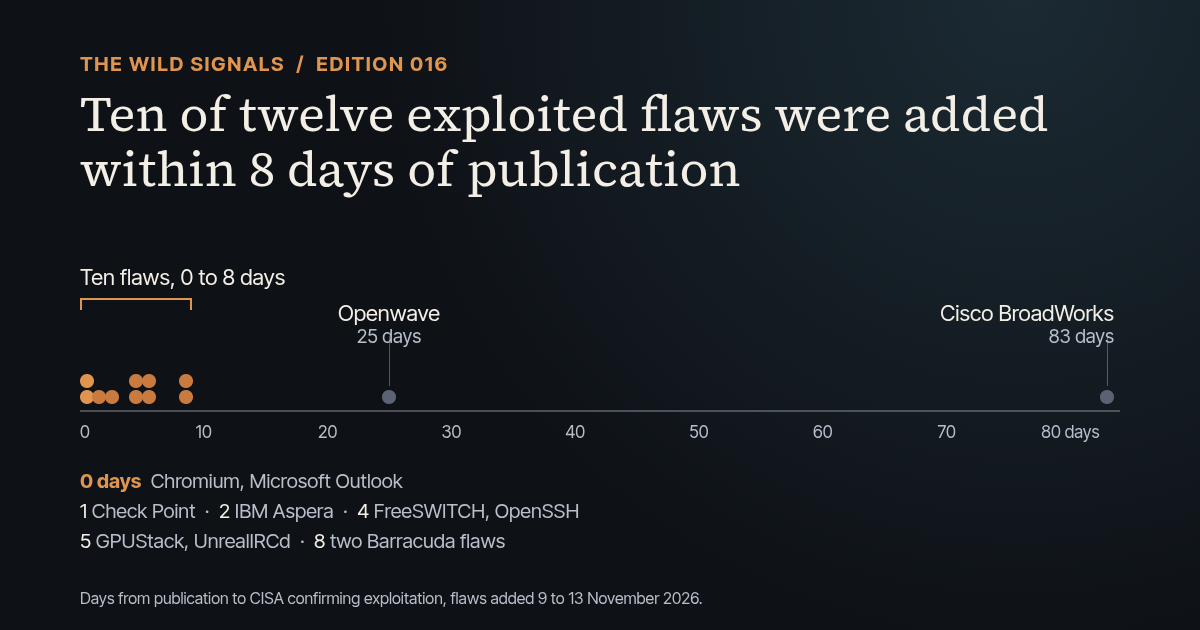

Same-day delivery has reached the exploited list. Two of the twelve flaws CISA added this week went from CVE to KEV on the day they were published, and ten took eight days or less.
SECTION 01
What the signals mean
Events recorded on the Venus decoys rose 31.4% this week, to 1,501,915 from 1,143,098, and distinct sources fell 23.6%, to 6,002 from 7,852. The Windows surface supplied 1,437,848 of the events and more than the whole increase: every other surface together fell 30.3%, to 64,067 from 91,861. 3,536 sources were new and 2,466 had been seen before, against 5,496 and 2,356 in Edition 015.
Twelve flaws joined the exploited list
Between 9 and 13 November, CISA added twelve vulnerabilities to its catalogue of flaws confirmed as exploited. Eight carry a three-day remediation deadline and four carry 14 days. On 9 November came FreeSWITCH, IBM Aspera Faspex, GPUStack and OpenSSH. On 10 November came two Barracuda flaws, Chromium, Cisco BroadWorks, Microsoft Outlook and the Openwave media transcoder. UnrealIRCd and Check Point Gaia followed on 13 November. Edition 015 had three additions.
Ten of twelve took eight days or less
Chromium and Microsoft Outlook were published and added on 10 November. Check Point took one day, IBM Aspera two, FreeSWITCH and OpenSSH four, GPUStack and UnrealIRCd five and both Barracuda flaws eight. The Openwave flaw took 25 days and Cisco BroadWorks 83. The median is 4.5 days.
Nine forecasts below 0.03
Nine of the twelve carry exploitation forecasts below 0.03. OpenSSH scored highest at 0.1890, followed by the Barracuda email gateway at 0.1095 and Barracuda’s second flaw at 0.0908. CISA records no known ransomware use for any of the twelve.
Reported use
SecurityWeek reports attackers used PHP2Shell for the first foothold on Check Point gateways and CVE-2026-123039 to reach root, in destructive attacks. Bleeping Computer reports the OpenSSH flaw, named SSHole, is being used to run commands, steal credentials and keep access. The Hacker News reports attackers exploiting UnrealIRCd for command injection at server level, and SecurityWeek reports the Openwave and Cisco BroadWorks flaws used to leak configuration data after patches shipped. Google fixed its eighth exploited Chrome zero-day of 2026, and Microsoft’s November release patched 1,094 flaws, among them the Outlook zero-day.
PHP remote include requests rose fourfold
Requests carrying the PHP remote include pattern rose 307.1%, to 114 from 28, from four sources against five. The pattern pairs two PHP settings so that the interpreter loads and runs a file from another server. It maps to CVE-2012-1823, which is on the exploited catalogue, and it is a different flaw from PHP2Shell. Nearly all of the sessions were automated. The decoys also recorded three Langflow exploit requests from one source and one probing request, against none in Edition 015.
Secrets requests fell with the sources behind them
Requests for secrets and configuration files fell 31.7%, to 19,821 from 29,038. They came from 514 sources against 1,517, so each source asked for about 39 files against 19. Distinct paths fell to 1,277 from 1,600. The five most requested paths fell between 7% and 18%: /.env drew 430 requests, /.git/config 287, /.env.production 203, /.env.local 202 and /api/.env 190. The loss is in the long tail of rarely requested paths.
Backup requests rose across 385 paths
Requests for backup and archive files rose 73.3%, to 735 from 424, across 385 distinct paths against 28, from 36 sources against 46. Terraform state, the record of the servers and passwords a cloud build created, drew 47 requests for the nested file and 46 for the root file, and every one of the five most requested backup paths fell. Traversal requests fell 50.0%, to 745 from 1,491, from 50 sources against 190. Four static-folder variants ending in an environment file and a log-download route drew 22 requests each.
Gateway fingerprinting rose while VPN events fell
VPN events fell 14.5%, to 5,171 from 6,051, and gateway fingerprinting rose to 11 requests from 6 sources, against 3 from 2. Auth events rose 17.4%, to 3,657 from 3,115. SSH access probing fell 14.0%, to 16,268 from 18,925, and invalid-user enumeration fell 16.4%, to 15,151 from 18,126. Windows file sharing probes fell 21.1% and file sharing credential attacks 22.3%, so the rise in Windows events sits outside those two signals. Requests for server-side script files fell 44.2%, to 5,323 from 9,536, and requests matching the WordPress login-bypass identifier CVE-2023-2982 fell 88.8%, to 82 from 730, a week after rising 465.9%.
The fingerprint cluster fell to its lowest since Edition 010
The remote desktop tool identified by fingerprint 73ede1f461b6 ran from 90 addresses and produced 2,192 sessions, against 132 addresses and 3,738 sessions in Edition 015.
My view
Ten of the twelve flaws reached the catalogue within eight days of publication, and nine were forecast below 0.03. Sorted by forecast, most of them would have come last. Waiting for the catalogue entry means a three-day deadline is already running on eight of them. I start the clock at the vendor advisory for anything an outsider can reach, and for browsers and mail clients.
Edition 015’s three flaws took 0, 3 and 904 days. This week’s median is 4.5 days. Cisco BroadWorks took 83 days and the Openwave transcoder 25, and reporting says both were exploited after patches existed.
None of the 49 flaws Medulus qualified appears among the 15 identifiers Venus recorded. 99.2% of the CVE-identified hits on the decoys are for flaws from 2022 or earlier, and 30 of the 49 qualifiers carry 2026 identifiers.
Requests for secrets files fell 31.7% and the sources behind them fell 66.1%. Removing secrets from any web-reachable path covers any number of sources.
What to act on
Patch OpenSSH, FreeSWITCH, IBM Aspera Faspex, GPUStack, both Barracuda flaws, UnrealIRCd and Check Point first; their federal deadlines ran from 12 to 16 November. Chromium and Microsoft Outlook updates are due 24 November, along with Cisco BroadWorks and the Openwave transcoder. On Alpine Linux and other musl-based hosts, list accounts without a password hash. Remove environment files, Git directories, Terraform state and site archives from any path a web server can reach.
9 Nov – 15 Nov 2026
9 Nov – 15 Nov 2026
1,501,915 external events (+31.4%). 6,002 distinct sources (−23.6%). 14,698 sessions (−9.3%).
Against Edition 015’s published figures, events rose from 1,143,098 to 1,501,915, sources fell from 7,852 to 6,002 and sessions from 16,201 to 14,698. New sources fell 35.7%, to 3,536 from 5,496, and returning sources rose 4.7%, to 2,466 from 2,356. By surface, Shell fell 14.0% to 16,268 from 18,925, Web fell 34.2% to 30,852 from 46,918, Database rose 1.1% to 1,635 from 1,617, API fell 57.4% to 3,245 from 7,622, Portal fell 57.5% to 3,239 from 7,613, Auth rose 17.4% to 3,657 from 3,115, VPN fell 14.5% to 5,171 from 6,051 and Windows rose 36.8% to 1,437,848 from 1,051,237. Active campaigns fell 3.3%, to 1,858 from 1,922, and 1,424 are flagged recurring.
Ranked signals
| Rank | Signal | Events | Ed. 015 | Change | Sources | Score |
|---|---|---|---|---|---|---|
| 1 | PHP Injection / Remote Include | 114 | 28 | +307.1% | 4 | 0.7041 |
| 2 | AI Workflow Builder Exploit Attempts | 3 | none | new | 1 | 0.5500 |
| 3 | Webshell / RCE Script Probing | 5,323 | 9,536 | −44.2% | 214 | 0.4524 |
| 4 | SSH Campaign Targeting | 1,137 | 993 | +14.5% | 70 | 0.3319 |
| 5 | Admin Console Discovery | 1,849 | 3,293 | −43.9% | 153 | 0.3167 |
| 6 | MySQL Credential Attack | 1,300 | 1,277 | +1.8% | 84 | 0.2974 |
| 7 | Directory / Path Traversal | 745 | 1,491 | −50.0% | 50 | 0.2930 |
| 8 | VPN Gateway Fingerprinting | 11 | 3 | +266.7% | 6 | 0.2774 |
| 9 | SMB Credential Attack | 130,792 | 168,233 | −22.3% | 44 | 0.2505 |
| 10 | Sensitive File & Secret Exposure | 19,821 | 29,038 | −31.7% | 514 | 0.2501 |
| 11 | SMB Access Probing | 141,849 | 179,689 | −21.1% | 2,049 | 0.1785 |
| 12 | AI Workflow Builder Probing | 1 | none | new | 1 | 0.1750 |
| 13 | SSH Invalid-User Enumeration | 15,151 | 18,126 | −16.4% | 419 | 0.1448 |
| 14 | Automated Scanner / Recon Tooling | 783 | 905 | −13.5% | 127 | 0.1388 |
| 15 | SSH Access Probing | 16,268 | 18,925 | −14.0% | 835 | 0.1327 |
| 16 | SQL Injection Probing | 1 | 1 | +0.0% | 1 | 0.1000 |
Atlassian Data Center exploit attempts fell to 0 from 2.
Remote desktop fingerprint campaigns
| Client signature | Sessions | Ed. 015 | Change | Sources | Ed. 015 | Change |
|---|---|---|---|---|---|---|
TLS 73ede1f461b6 | 2,192 | 3,738 | −41.4% | 90 | 132 | −31.8% |
| RDP cookie "hello" | 270 | 432 | −37.5% | 90 | 50 | +80.0% |
| TLS 43e25370946f | 248 | 428 | −42.1% | 74 | 47 | +57.4% |
Sessions fell for all three signatures while the "hello" cookie rose from 50 addresses to 90 and 43e25370946f from 47 to 74. An address can carry several signatures, so the three counts are not totalled.
Path families
| Family | Events | Ed. 015 | Change | Paths | Ed. 015 | Sources | Most requested |
|---|---|---|---|---|---|---|---|
| Sensitive File & Secret Exposure | 19,821 | 29,038 | −31.7% | 1,277 | 1,600 | 514 | /.env (430), /.git/config (287) |
| Backup & Archive Download Probing | 735 | 424 | +73.3% | 385 | 28 | 36 | /.terraform/terraform.tfstate (47), /terraform.tfstate (46) |
| Webshell / RCE Script Probing | 5,323 | 9,536 | −44.2% | 1,366 | 2,021 | 214 | /phpinfo.php (140), /info.php (125) |
| Admin Console Discovery | 1,849 | 3,293 | −43.9% | 369 | 491 | 153 | /admin/.env (132), /dashboard/.env (70) |
| Directory / Path Traversal | 745 | 1,491 | −50.0% | 56 | 62 | 50 | /css../.env (22), /dist../.env (22) |
| SQL Injection Probing | 1 | 1 | +0.0% | 1 | 1 | 1 | /admin/ajax.php (1) |
Distinct paths fell in every family except backup and archive, which rose to 385 from 28, and SQL injection, which held at 1. The two most requested admin paths both end in .env, a file also requested in the sensitive-file family. The single SQL injection request asked for /admin/ajax.php, where Edition 015’s asked for the site root.
Representative paths
| Secrets and configuration | Events | Ed. 015 | Backup and archive | Events | Ed. 015 |
|---|---|---|---|---|---|
/.env | 430 | 462 | /.terraform/terraform.tfstate | 47 | 52 |
/.git/config | 287 | 325 | /terraform.tfstate | 46 | 57 |
/.env.production | 203 | 246 | /backup.tar.gz | 37 | 41 |
/.env.local | 202 | 217 | /backup.zip | 37 | 41 |
/api/.env | 190 | 208 | /site.zip | 21 | 32 |
All ten paths fell, between 7% and 34%. In the webshell family /phpinfo.php rose 12.0%, to 140 from 125, and Edition 015’s three login paths are no longer among the five most requested. In the admin family /admin/.env fell 17.0%, to 132 from 159, and /dashboard/.env fell 44.4%, to 70 from 126.
Behaviour progression
339 sessions carried behaviour from two or more distinct stages, against 329 in Edition 015.
| Ordering | Sessions | Ed. 015 | Change | Sources | Ed. 015 | Busiest source | Ed. 015 |
|---|---|---|---|---|---|---|---|
| Discovery, then Exploitation | 275 | 279 | −1.4% | 168 | 170 | 20 (7.27%) | 19 (6.81%) |
| Exploitation, then Discovery | 64 | 50 | +28.0% | 50 | 37 | 7 (10.94%) | 10 (20.00%) |
Sessions that ran exploitation before discovery rose 28.0%, while the share held by their busiest source fell to 10.94% from 20.00%. A tool that issues credential attempts before enumeration produces a descending ordering without any escalation.
Vulnerability mapping
| Identifier | Description | Hits | Ed. 015 | Change | Sources | KEV |
|---|---|---|---|---|---|---|
| CWE-312 | Cleartext secrets (.env) | 15,821 | 24,415 | −35.2% | 425 | no |
| CVE-2021-41773 | Apache traversal | 5,339 | 9,544 | −44.1% | 216 | yes |
| CVE-2019-0232 | Tomcat CGI | 5,323 | 9,536 | −44.2% | 214 | no |
| CWE-527 | Exposed Git | 2,073 | 2,020 | +2.6% | 136 | no |
| CVE-2022-22963 | Spring Cloud Function | 117 | 112 | +4.5% | 29 | yes |
| CVE-2012-1823 | PHP-CGI argument injection | 114 | 28 | +307.1% | 4 | yes |
| CVE-2023-2982 | WordPress login bypass | 82 | 730 | −88.8% | 27 | no |
| CVE-2017-9841 | PHPUnit eval-stdin | 62 | 139 | −55.4% | 9 | yes |
| CVE-2022-22965 | Spring4Shell | 33 | 14 | +135.7% | 14 | yes |
| CVE-2021-42013 | Apache traversal, second fix | 16 | 8 | +100.0% | 7 | yes |
15 identifiers were reached, as in Edition 015, and 7 are on the KEV catalogue, against 6. CVE-2017-12629 and CVE-2021-27905 each drew 4 hits, against 5. The Langflow identifiers CVE-2025-3248 and CVE-2026-0768 drew 3 hits each from 1 source, against none, and CWE-89 drew 1 hit, as before. CVE-2026-21589 and CWE-22 recorded no hits, against 2 and 1.
Medulus correlation
49 vulnerabilities qualified this period, against 19 in Edition 015, and 30 carry 2026 identifiers. Twelve entered the CISA Known Exploited Vulnerabilities catalogue between 9 and 13 November.
| Product | Identifier | CVSS | EPSS | Published | Added | Days | Due | Reported exploitation |
|---|---|---|---|---|---|---|---|---|
| IBM Aspera Faspex | CVE-2026-123218 | 9.8 | 0.0053 | 7 Nov | 9 Nov | 2 | 12 Nov | SecurityWeek, The Hacker News |
| SignalWire FreeSWITCH | CVE-2026-116779 | 9.8 | 0.0247 | 5 Nov | 9 Nov | 4 | 12 Nov | SecurityWeek, The Hacker News |
| GPUStack | CVE-2026-102895 | 9.8 | 0.0052 | 4 Nov | 9 Nov | 5 | 12 Nov | The Hacker News |
| OpenSSH | CVE-2026-123158 | 8.1 | 0.1890 | 5 Nov | 9 Nov | 4 | 12 Nov | Bleeping Computer |
| Barracuda Email Security Gateway | CVE-2026-116606 | 9.8 | 0.1095 | 2 Nov | 10 Nov | 8 | 13 Nov | – |
| Barracuda, multiple products | CVE-2026-111560 | 7.2 | 0.0908 | 2 Nov | 10 Nov | 8 | 13 Nov | – |
| Google Chromium | CVE-2026-125350 | 8.8 | 0.0096 | 10 Nov | 10 Nov | 0 | 24 Nov | The Hacker News |
| Microsoft Outlook | CVE-2026-124194 | 6.5 | 0.0162 | 10 Nov | 10 Nov | 0 | 24 Nov | SecurityWeek |
| Cisco BroadWorks | CVE-2026-20320 | 7.5 | 0.0098 | 19 Aug | 10 Nov | 83 | 24 Nov | SecurityWeek, The Hacker News |
| Openwave Webtop Media Transcoder | CVE-2026-111793 | 4.3 | 0.0064 | 16 Oct | 10 Nov | 25 | 24 Nov | SecurityWeek, The Hacker News |
| UnrealIRCd | CVE-2026-114713 | 8.6 | 0.0051 | 8 Nov | 13 Nov | 5 | 16 Nov | The Hacker News |
| Check Point Gaia | CVE-2026-123039 | 7.8 | 0.0219 | 12 Nov | 13 Nov | 1 | 16 Nov | SecurityWeek |
Nine of the twelve have an EPSS score below 0.03. EPSS is a forecast of exploitation within 30 days. The Barracuda gateway flaw lets an unauthenticated attacker restore a crafted backup archive and change the appliance’s configuration. The second Barracuda flaw needs an administrator, who can inject shell commands through the timezone field. The OpenSSH flaw affects Linux builds that use musl libc without PAM, such as Alpine Linux: for some account configurations any password between 256 and 1024 characters succeeds. GPUStack treated a request from a loopback address as the administrator, and a remote request could appear to come from one through a proxy or a client-supplied header. FreeSWITCH lets an accepted SIP message run API commands, including operating-system commands. The Check Point flaw is a root-level daemon listening on a world-writable local socket.
Other reporting: Apache patched a critical code execution flaw in the HTTP/2 module, CVE-2026-119618, found by Anthropic and Google; PostgreSQL patched 52 flaws, including CVE-2026-6460, a 22-year-old bug that allows authenticated code execution; Citrix patched 12 NetScaler and Secure Access Client flaws, including an authentication bypass; and Rapid7 published an advisory on N-able N-central after the vendor shut down its hosted service. The Hacker News reports the two AhsayCBS flaws from Edition 012 used to deploy a Python backdoor, and SCKit malware reaching ScreenConnect through a patched flaw. None of the Apache, PostgreSQL or Citrix flaws is on the catalogue. A public exploit, Exploit-DB 52705, targets the Ruflo MCP bridge, CVE-2026-59726 (CVSS 10.0, EPSS 0.0624, not listed). Metasploit changed 15 modules, among them cPanel & WHM CVE-2026-41940 (EPSS 0.9853, with known ransomware use), PaperCut CVE-2026-81578, Open Web Analytics CVE-2022-24637 (EPSS 0.9906, not listed) and the six SMB identifiers behind EternalBlue. CISA published seven advisories, for Jet Admin, Catalis WebPro, iDentalSoft, AsiaInfo BSS, Chargemap, BeeS ERP and a U.S. Geological Survey platform.
Seven malware families were named in reporting: CastleRAT, GootLoader, Stealc, FaceStealer, AsyncRAT, DCRat and Qilin. Nine actors were named: Turla, WhiteArmor, Blind Eagle, Bottle, HAZY TIGER, Luna Moth, Pioneer, ShinyHunters and Unit 8200. Medulus recorded a certificate for e7sy.com, a lookalike of etsy.com, first logged on 24 October. A certificate on a lookalike name is not proof of impersonation.
Venus and Medulus together
None of the 49 vulnerabilities qualified by Medulus appears among the 15 identifiers recorded on the decoys.
| Subject | Medulus | Venus | Overlap |
|---|---|---|---|
| Gateways | Check Point Gaia and the Barracuda email gateway added to the exploited catalogue | VPN events −14.5%; gateway fingerprinting 11 requests from 6 sources | Same product class, no shared identifier |
| SSH | OpenSSH password bypass added, EPSS 0.1890 (Bleeping Computer) | SSH access probing −14.0%, invalid-user enumeration −16.4%, campaign targeting +14.5% | Same service, no mapped identifier |
| AI workflow and model servers | GPUStack added; public exploit for the Ruflo MCP bridge (Exploit-DB) | Langflow exploit requests 3 from 1 source, against none | Different products |
Technical checks for the week
- Patch: OpenSSH to 10.6p2 or later on musl builds without PAM. FreeSWITCH to 1.11.3. GPUStack to 2.2.0. UnrealIRCd to 6.2.7.1. Barracuda Email Security Gateway to 9.4.0.030. Chromium-based browsers to 157.0.8103.50 or later.
- Patch: IBM Aspera Faspex 5.0.0 through 5.0.19, Check Point Gaia, the second Barracuda flaw, Microsoft Outlook, Cisco BroadWorks and the Openwave transcoder, per their vendors. The BroadWorks fix has been available since August.
- Review: reverse proxies in front of GPUStack and FreeSWITCH, so a client cannot supply a loopback address or reach the SIP chat handler without authentication.
- Check: Alpine Linux and other musl hosts for accounts without a password hash, and Check Point gateways that ran PHP2Shell-affected software.
- Prioritise: Apache HTTP Server with HTTP/2 enabled (CVE-2026-119618), N-able N-central and PostgreSQL. Each has a published advisory or critical rating, and none is on the catalogue.
- Remove: Terraform state, site archives,
.gitdirectories and every.envvariant from web-reachable paths. Folder aliases should end in a slash, so a request for a folder name followed by two dots cannot step outside it.
Venus records activity reaching Elytra-operated decoy observation infrastructure. Medulus provides public vulnerability and threat-intelligence context. Every observed request is an attempt. Week-on-week comparisons are drawn from the figures published in Edition 015.